
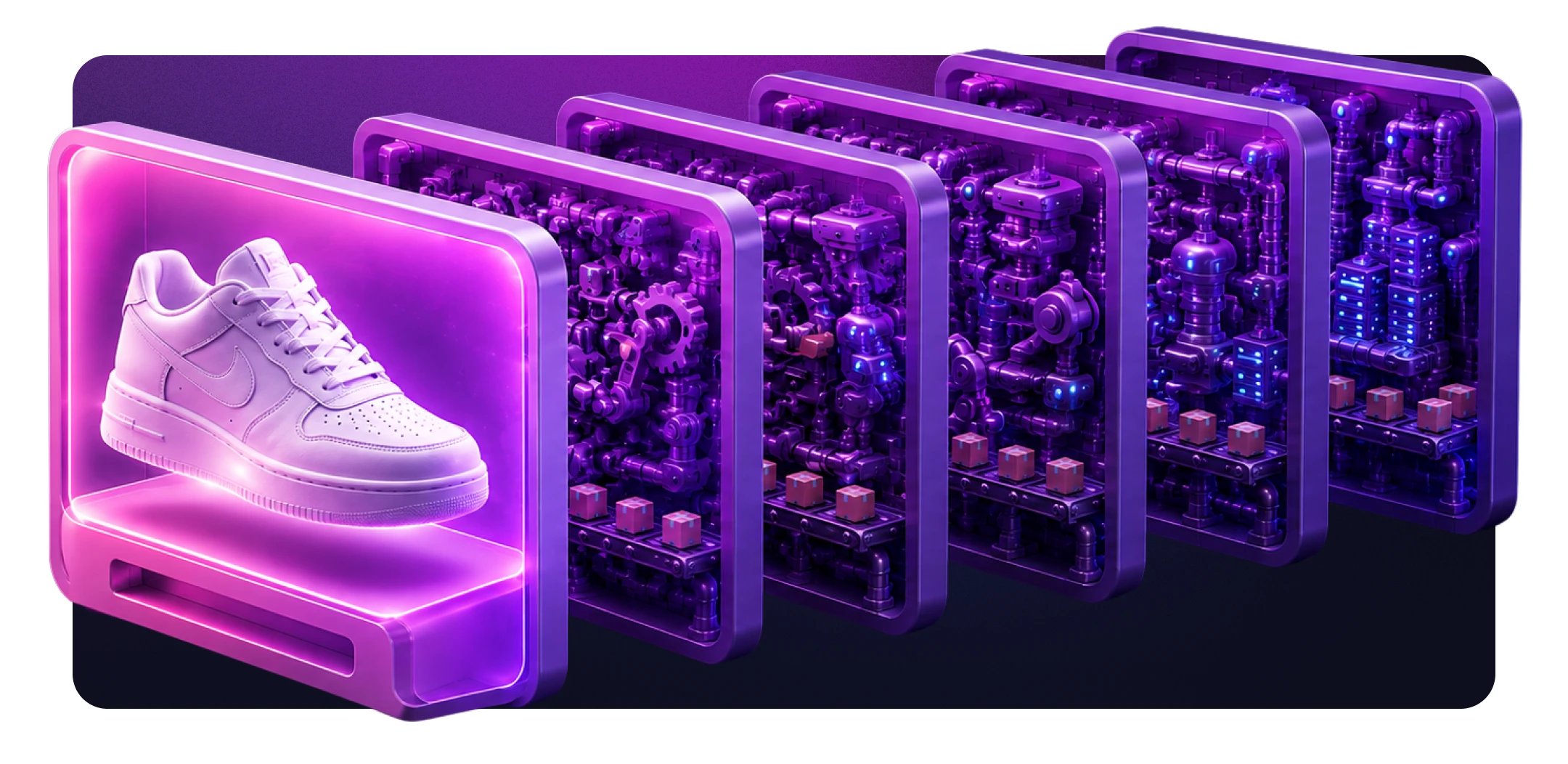
Understandably, many organizations want to build these experiences themselves. AI has made that prospect look increasingly achievable: connect a foundation model to product data, use new coding tools to accelerate development, and presto! Your team suddenly has an impressive prototype up-and-running.
But when it comes time to scale these solutions, that simplicity disappears. Modern commerce depends on enormous, messy, constantly changing product catalogs, accurate retrieval, live pricing and availability, and infrastructure capable of handling real-world scale. When a team thinks “we can build this ourselves,” the experience they see is only a fraction of what they’re signing up to build.
Why “we can build it ourselves” only gets you so far
We talk to companies every day that have underestimated what it takes to build commerce infrastructure. Some have a prototype that demos well but struggles at production scale. Others spend months building only to find that the results don’t meet the bar, or that basics like current inventory and pricing still require work. And some spend a year saying “we can build this” without ever getting it off the roadmap.
Getting something into production doesn’t necessarily solve the problem, either, as commerce infrastructure requires constant attention as catalogs change, feeds need monitoring, and models need tuning. Teams that successfully build their own solution will find their limited engineering resources permanently scoped to maintaining it.
That’s a significant commitment for technology that sits underneath the customer experience. For many teams, the question to consider is how much time and engineering capacity they want to devote to building and maintaining the foundation before they can focus on the commerce experience itself.
Where the complexity of commerce lives
What exactly makes a commerce system like this so hard to engineer?
- Product data is messy by nature, with retailers using different naming conventions, taxonomies, descriptions, and attributes. For any given product, information can be incomplete and inventory or pricing inaccurate. The same product might even appear differently across multiple feeds.
- Retrieval adds another layer of complexity. A useful commerce system needs to understand what someone is looking for and find the right product, or a genuinely relevant alternative, across a large and changing catalog.
- Scale magnifies these challenges. Systems that perform well during development can encounter very different constraints around latency, compute, and reliability as catalogs and traffic grow.
And the work continues after launch. Feeds need monitoring, models need tuning, and product relationships need updating. Adding specialized tools for each problem can help, but it also leaves engineering teams responsible for integrating and maintaining an increasingly complicated stack.
Where engineering teams create the most value
This complexity is why the most useful “build-versus-partner” conversations start with where a company wants its engineers spending their time. Retailers know how customers explore its assortment, media companies understand their content and audience, and technology platforms know the product experience they want to create. These are the areas where internal teams can build something genuinely distinctive.
Recreating the infrastructure underneath those experiences, however, often requires years of engineering work. Catalog normalization, feed enrichment, product retrieval, model tuning, and the systems required to operate them at scale all demand immense resources before any customer encounters the experience itself.
As a result, the question for technical leaders becomes: How much of this foundation do we really need to own ourselves?
How Shoppable Intelligence helps teams build faster
Shopsense has spent years building the technology required to power digital commerce at scale. At the center is our Shoppable Intelligence Model (SIM), a purpose-built AI model that understands products, content, and shopping intent, supported by the product data and infrastructure required to put that intelligence to work in actual commerce environments.
Companies can leverage SIM’s capabilities in different ways. For example, Shopsense can power ready-to-use commerce experiences, from product discovery and recommendations to shoppable content and monetization. For teams building their own products, the same Shoppable Intelligence can serve as underlying infrastructure by allowing them to own the application, customer experience, and business model without needing to rebuild the specialized commerce technology beneath it.
Flexibility like this is critical as AI makes prototypes faster to build. The distance between a good demo and a dependable commerce product remains substantial, especially when that product has to support large catalogs, changing inventory, peak traffic, and revenue.
Of course, companies should continue to be ambitious about the commerce experiences they want to create with AI. Some will need a solution they can put to work quickly. Others will have a specific product or experience they want to build themselves. In both cases, years of work around product data, retrieval, and model performance are no longer necessary. Instead, SIM gives companies a solution that already works at scale, then lets them decide how they’ll put it to work.
Thinking about building a new commerce experience? Reach out to us today about how SIM will help you get there faster.
